
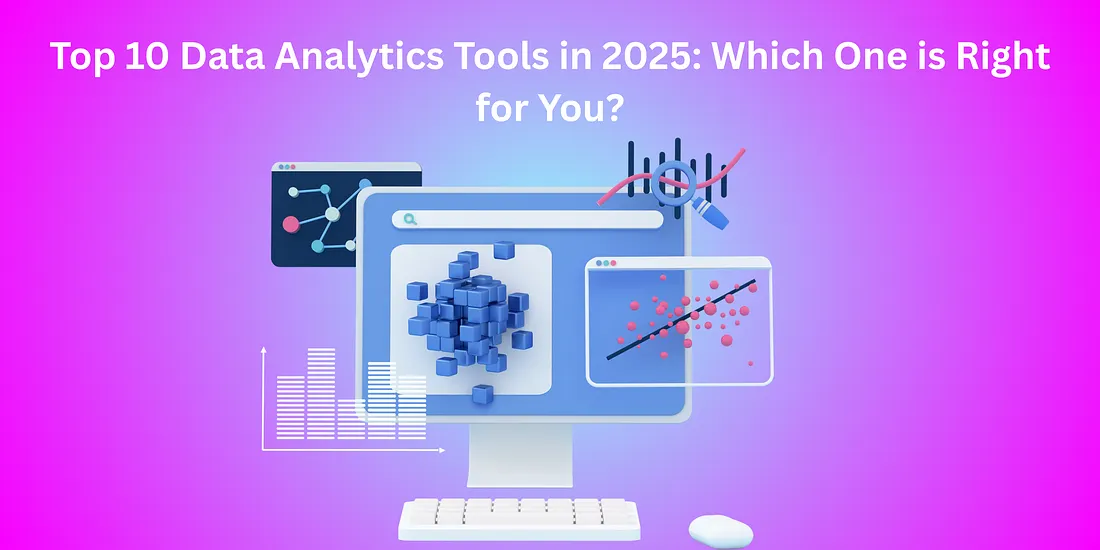
Top 10 Data Analytics Tools in 2025: Which One is Right for You?
In the rapidly evolving world of data, choosing the right analytics tool in 2025 can be the difference between raw numbers and real business insights. Whether you’re a student stepping into the field or a working professional aiming to upgrade your skill set, understanding which tools dominate the data analytics landscape is crucial.
In this blog, we’ll walk you through the top 10 data analytics tools of 2025, their strengths, ideal use cases, and how to choose the one that aligns best with your goals.
1. Python
Python continues to be a dominant force in the data analytics world, thanks to its simplicity, flexibility, and massive library support. Libraries like Pandas, NumPy, SciPy, Matplotlib, and Scikit-learn allow analysts to clean, manipulate, visualize, and model data efficiently.
Best for: Data wrangling, automation, machine learning, and custom analytics solutions
Why use it: Open-source, versatile, strong community support, integrates with web apps and dashboards
2. R
R is another powerful programming language designed specifically for statistical computing and graphics. It offers rich packages like ggplot2, dplyr, and caret, making it a go-to tool for statisticians and data scientists.
Best for: Statistical modeling, data visualization, academic research
Why use it: Extensive statistical libraries, great for visual storytelling, strong CRAN package ecosystem
3. Power BI
Power BI by Microsoft remains a top choice in 2025 for business intelligence and interactive dashboard creation. Its user-friendly interface and seamless integration with Microsoft Office tools make it ideal for organizations of all sizes.
Best for: Interactive reports, business dashboards, enterprise reporting
Why use it: Drag-and-drop features, real-time data access, integration with Excel and Azure
4. Tableau
Tableau continues to be a leading data visualization tool, especially favored for its visual power and intuitive dashboarding capabilities. In 2025, Tableau is focusing more on AI-driven analytics and augmented insights.
Best for: Visual analytics, storytelling with data, collaborative dashboards
Why use it: Real-time analytics, high-quality visuals, extensive connector support
5. Excel (Advanced)
While Excel is often seen as a beginner’s tool, in 2025 it is still heavily used in data analytics with advanced functionalities like Power Query, Power Pivot, and dynamic arrays. It remains essential in finance, marketing, and operations.
Best for: Financial modeling, quick data summaries, spreadsheet-based analytics
Why use it: Universally used, great for small-scale analysis, supports automation with VBA and Python
6. Google Looker Studio (formerly Data Studio)
This free and powerful tool from Google has grown tremendously. It integrates smoothly with Google Sheets, BigQuery, Google Ads, and other platforms. Looker Studio is ideal for marketers and startups that need interactive and shareable dashboards.
Best for: Marketing analytics, real-time reporting, Google ecosystem
Why use it: Easy to use, highly visual, no coding needed, real-time cloud integration
7. Apache Spark
Apache Spark is an open-source analytics engine for big data processing, with built-in modules for streaming, SQL, machine learning, and graph processing. Spark is used in large-scale data environments and cloud platforms.
Best for: Big data analytics, distributed data processing
Why use it: Scalable, fast, handles unstructured data, integrates with Hadoop and cloud services
8. SAS
SAS (Statistical Analysis System) is widely used in large enterprises, particularly in the finance, healthcare, and pharmaceutical sectors. Its predictive analytics and advanced statistical capabilities are trusted for regulated and mission-critical environments.
Best for: Predictive analytics, enterprise-level statistical modeling
Why use it: Reliable, secure, widely adopted in corporate analytics workflows
9. SQL
SQL is the backbone of data querying. In 2025, it still remains essential for data extraction, cleaning, and transformation. Tools like PostgreSQL, MySQL, and Microsoft SQL Server are critical in any data stack.
Best for: Data querying, database management, ETL processes
Why use it: Fundamental skill, efficient for structured data, essential in most data jobs
10. KNIME
KNIME (Konstanz Information Miner) is a free and open-source platform known for its visual workflow interface. It’s popular for data mining, machine learning, and ETL tasks, especially among non-programmers.
Best for: Workflow-based analytics, machine learning, data preprocessing
Why use it: No-code/low-code interface, powerful analytics engine, strong integration capabilities
How to Choose the Right Tool?
With so many tools available, it’s easy to feel overwhelmed. Here’s how to narrow it down:
1. Your Goal Matters
- Want to enter data science? Learn Python or R
- Interested in dashboards? Go with Power BI or Tableau
- Handling massive datasets? Explore Apache Spark
- Need industry-standard tools for business roles? Learn Excel and SQL
2. Your Background
- Non-programmers may prefer tools like Power BI, Tableau, or KNIME
- Programmers and engineers should focus on Python, SQL, and Spark
3. Your Industry
- Finance: Excel, SAS, Power BI
- Marketing: Looker Studio, Tableau
- Healthcare: R, SAS
- E-commerce: Python, SQL, Spark
The Future of Data Analytics in 2025 and Beyond
The future of data analytics lies in automation, AI, real-time analysis, and self-service BI tools. We’re seeing a convergence of no-code platforms with AI-powered features that allow businesses to extract insights faster than ever before.
However, fundamentals still matter. Strong analytical thinking, a good grasp of statistics, and a solid foundation in tools like Python, SQL, and Power BI dashboards are what separate skilled analysts from average ones.
Conclusion
In 2025, the data analytics landscape is more diverse than ever. Whether you’re building your career or improving business processes, choosing the right tool is about aligning with your goals, not following trends blindly. Start small, stay consistent, and keep building your data mindset.
Want to Learn Data Analytics with Expert Guidance?
At Virash Training Institute, we offer industry-relevant, hands-on training in data analytics, covering tools like Python, SQL, Power BI, and more. Whether you’re just starting out or looking to switch careers, our expert-led programs are designed to get you job-ready.

Virash
Unlock your potential at Virash Training Institution. Offering courses in full-stack web development, data analytics, mobile app development, and more!
Trending Posts
-
 Why Every Student Should Learn Data Analytics in 2025
August 13, 2025
Why Every Student Should Learn Data Analytics in 2025
August 13, 2025
-
 Top Flutter Plugins You Should Be Using in 2025
August 14, 2025
Top Flutter Plugins You Should Be Using in 2025
August 14, 2025
-
 Top 10 Java Frameworks Every Full Stack Developer Should Know in 2025
September 30, 2025
Top 10 Java Frameworks Every Full Stack Developer Should Know in 2025
September 30, 2025
-
 10 Common Flutter Mistakes Every Developer Makes (And How to Avoid Them in 2025)
September 30, 2025
10 Common Flutter Mistakes Every Developer Makes (And How to Avoid Them in 2025)
September 30, 2025
-
 Step-by-Step Guide to Building a Flutter E-Commerce App (2025 Edition)
October 7, 2025
Step-by-Step Guide to Building a Flutter E-Commerce App (2025 Edition)
October 7, 2025
-
 FastAPI vs Django: Which Python Backend Framework Should You Learn First in 2025?
October 15, 2025
FastAPI vs Django: Which Python Backend Framework Should You Learn First in 2025?
October 15, 2025
-
 How to Become a Full Stack MERN Developer Without a CS Degree (Step-by-Step 2025 Guide)
October 16, 2025
How to Become a Full Stack MERN Developer Without a CS Degree (Step-by-Step 2025 Guide)
October 16, 2025
-
 AI-Powered Full Stack Development: How MERN Developers Can Leverage AI Tools in 2025
October 22, 2025
AI-Powered Full Stack Development: How MERN Developers Can Leverage AI Tools in 2025
October 22, 2025