
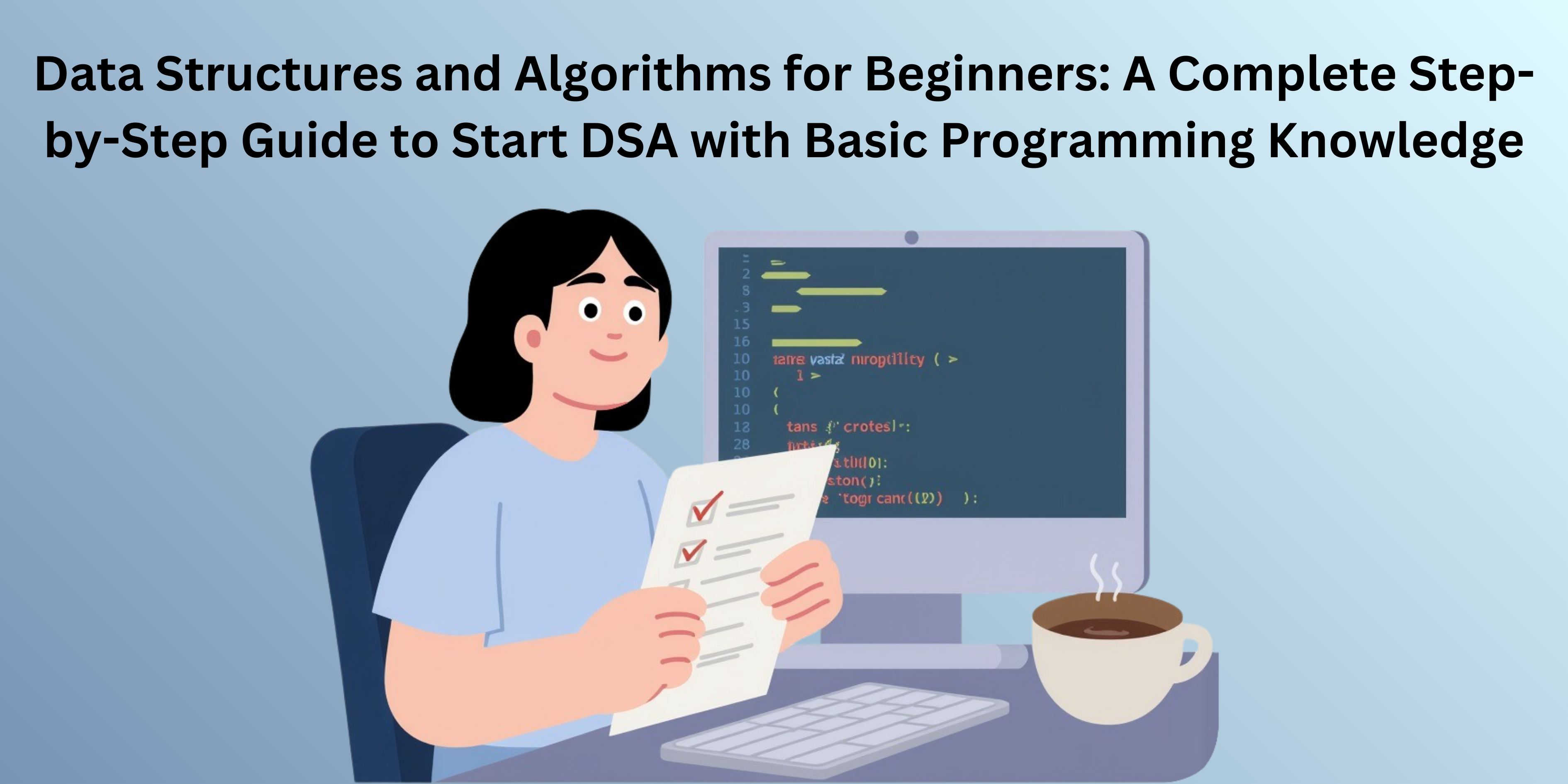
Data Structures and Algorithms for Beginners: A Complete Step-by-Step Guide to Start DSA with Basic Programming Knowledge
Published on: December 25, 2025
If you know only basic programming and want to grow into a confident software developer, learning Data Structures and Algorithms (DSA) is the most important step. Many beginners believe DSA is only for advanced programmers or top product-based company interviews, but the truth is that DSA builds your thinking, logic, and problem-solving ability from the ground up.
When you write programs without understanding DSA, your code may work, but it will not be efficient, scalable, or optimized. Companies today look for candidates who not only know a programming language but also understand how data is stored, accessed, and manipulated efficiently. This is exactly where DSA plays a major role.
Even if you know only basic concepts like variables, loops, conditions, and functions, you are ready to start learning DSA. You do not need advanced programming skills to begin; you need the right roadmap, consistency, and proper guidance.
What Data Structures and Algorithms Actually Mean in Simple Language
For beginners, DSA often sounds scary because of complex definitions. Let’s simplify it.
Data Structures are ways to organize and store data so that it can be used efficiently. When your program handles data properly, it becomes faster and more reliable.
Algorithms are step-by-step methods to solve a problem. An algorithm defines how to process the data stored in a data structure to get the desired result.
In real life, imagine your cupboard. If clothes are arranged properly, you can find what you want quickly. That arrangement is a data structure. The steps you follow to find your shirt are the algorithm.
Who Should Learn DSA as a Beginner
DSA is useful for:
- Students starting their programming journey
- Freshers preparing for IT jobs
- Career switchers entering the software industry
- Anyone aiming for software development, web development, app development, or data-related roles
If you know basic programming concepts in languages like C, C++, Python, or Java, you are perfectly eligible to start learning DSA.
Best Programming Language to Start DSA for Beginners
Beginners often get confused about which language is best for learning DSA. The truth is that DSA concepts are language-independent, but beginners should choose a language they already know.
- C is great for understanding memory and logic deeply
- C++ is widely used for competitive programming
- Python is beginner-friendly and easy to read
- Java is popular for enterprise-level development
If you already know one language at a basic level, stick with it. Learning DSA is about understanding logic, not switching languages repeatedly.
How to Build the Right Mindset Before Starting DSA
Many beginners quit DSA because they expect instant results. DSA is not about memorizing solutions; it is about training your brain to think logically.
You must accept that:
- You will feel confused in the beginning
- You will not solve problems instantly
- Making mistakes is part of learning
- Consistency matters more than speed
Start slow, focus on clarity, and improve step by step.
Step-by-Step DSA Roadmap for Beginners
Step 1: Strengthen Basic Programming Concepts
Before touching DSA topics, make sure you are comfortable with:
- Variables and data types
- Conditional statements
- Loops
- Functions
- Basic input and output
Without these fundamentals, DSA will feel overwhelming.
Step 2: Learn Basic Data Structures First
Start with simple and commonly used data structures:
- Arrays
- Strings
- Recursion basics
- Searching techniques
- Sorting basics
These topics help you understand how data behaves in memory and how operations affect performance.
Step 3: Move to Linear Data Structures
Once basics are clear, focus on linear data structures such as:
- Linked Lists
- Stacks
- Queues
These structures improve your understanding of memory allocation, data flow, and real-world problem-solving.
Step 4: Understand Non-Linear Data Structures
After linear structures, slowly move towards:
- Trees
- Binary Trees
- Binary Search Trees
- Heaps
- Graph basics
Non-linear data structures improve analytical thinking and are widely used in real-world applications.
Step 5: Learn Algorithms Side by Side
While learning data structures, algorithms must be practiced together:
- Searching algorithms
- Sorting algorithms
- Recursion-based problem solving
- Basic greedy approach
- Introductory dynamic programming
Do not rush advanced algorithms early. Focus on understanding the logic.
Importance of Time Complexity and Space Complexity
One of the most important concepts in DSA is time complexity and space complexity. Beginners often ignore this, but companies value developers who can write optimized solutions.
Time complexity helps you understand how fast your algorithm runs as input size increases. Space complexity helps you understand memory usage.
Learning complexity analysis early improves your coding quality and interview performance.
Common Mistakes Beginners Make While Learning DSA
Many beginners struggle because of these mistakes:
- Jumping directly to advanced problems
- Memorizing solutions instead of understanding logic
- Not practicing regularly
- Switching languages frequently
- Skipping fundamentals
Avoiding these mistakes will make your DSA journey smoother and more productive.
How Consistent Practice Improves DSA Skills
DSA cannot be mastered by watching videos alone. You must practice regularly.
- Solve beginner-level problems daily
- Revise concepts frequently
- Analyze mistakes
- Try multiple approaches to one problem
Consistency builds confidence and improves logical thinking.
How DSA Helps in Real-World Software Development
DSA is not only for interviews. It helps in:
- Writing efficient backend logic
- Optimizing database queries
- Improving application performance
- Handling large data efficiently
- Building scalable applications
Strong DSA knowledge makes you a better developer overall.
Why Structured Training Makes Learning DSA Easier
Many beginners try to learn DSA randomly and get stuck. A structured learning path with mentorship helps avoid confusion.
This is where professional training institutes play a major role by providing:
- Clear learning roadmap
- Practical problem-solving sessions
- Continuous evaluation
- Interview preparation
Learning DSA with Guidance at Virash Training Institute
At Virash Training Institute, beginners are guided step by step into the world of Data Structures and Algorithms with a strong foundation approach. The training methodology focuses on building logic from basic programming concepts and gradually advancing toward complex problem-solving skills.
Students are taught how to think, analyze, and approach problems instead of memorizing answers. This approach helps learners become confident programmers who can handle real-world development challenges and technical interviews effectively.
How Virash Training Institute Supports Beginners in DSA
Virash Training Institute is known as “The Trusted Name for Specialised Training”, offering career-oriented IT courses designed for students, freshers, and working professionals. With a strong focus on practical learning, the institute ensures that every beginner understands DSA concepts clearly and applies them confidently.
The structured curriculum, experienced trainers, and placement-oriented guidance make learning DSA easier and more effective for students who start with only basic programming knowledge.
Final Tips for Beginners Starting DSA
- Start slow and stay consistent
- Focus on understanding, not memorization
- Revise concepts regularly
- Practice daily
- Do not compare your progress with others
Learning DSA is a journey, not a race. With the right mindset and guidance, anyone can master it.
Conclusion
Data Structures and Algorithms may seem challenging at first, but they are the backbone of successful programming careers. If you know only basic programming, you are already ready to start. With consistent practice, clear concepts, and structured learning, DSA becomes simple, logical, and even enjoyable.
Invest time in building strong fundamentals today, and your future as a software developer will become much brighter.

Virash
Unlock your potential at Virash Training Institution. Offering courses in full-stack web development, data analytics, mobile app development, and more!
Trending Posts
-
 Why Every Student Should Learn Data Analytics in 2025
August 13, 2025
Why Every Student Should Learn Data Analytics in 2025
August 13, 2025
-
 Top Flutter Plugins You Should Be Using in 2025
August 14, 2025
Top Flutter Plugins You Should Be Using in 2025
August 14, 2025
-
 Top 10 Data Analytics Tools in 2025: Which One is Right for You?
August 14, 2025
Top 10 Data Analytics Tools in 2025: Which One is Right for You?
August 14, 2025
-
 Top 10 Java Frameworks Every Full Stack Developer Should Know in 2025
September 30, 2025
Top 10 Java Frameworks Every Full Stack Developer Should Know in 2025
September 30, 2025
-
 10 Common Flutter Mistakes Every Developer Makes (And How to Avoid Them in 2025)
September 30, 2025
10 Common Flutter Mistakes Every Developer Makes (And How to Avoid Them in 2025)
September 30, 2025
-
 Step-by-Step Guide to Building a Flutter E-Commerce App (2025 Edition)
October 7, 2025
Step-by-Step Guide to Building a Flutter E-Commerce App (2025 Edition)
October 7, 2025
-
 FastAPI vs Django: Which Python Backend Framework Should You Learn First in 2025?
October 15, 2025
FastAPI vs Django: Which Python Backend Framework Should You Learn First in 2025?
October 15, 2025
-
 How to Become a Full Stack MERN Developer Without a CS Degree (Step-by-Step 2025 Guide)
October 16, 2025
How to Become a Full Stack MERN Developer Without a CS Degree (Step-by-Step 2025 Guide)
October 16, 2025
-
 AI-Powered Full Stack Development: How MERN Developers Can Leverage AI Tools in 2025
October 22, 2025
AI-Powered Full Stack Development: How MERN Developers Can Leverage AI Tools in 2025
October 22, 2025